Full text available https://lnkd.in/g6pbXUg
Blogging on current global health issues and sharing conference presentations, posters and media
Monday, December 21, 2020
Poster HSR2020: Health System Considerations for Community-Based Implementation of Automated Respiratory Rate Counters to Identify Childhood Pneumonia in 5 Regions of Ethiopia
Presented at 6th Global Symposium on Health Systems Research, November 8-12, 2020 (Dubai-virtually due to COVID-19) Abstract below
Title: Health system considerations for community-based implementation of automated respiratory counters to identify childhood pneumonia in 5 regions of Ethiopia: A qualitative analysis
Introduction
Pneumonia,
the leading infectious cause of death among children under 5, is diagnosed by
measuring respiratory rates (RR) in low- and middle-income settings. RR
counting has limited accuracy and high variability, especially when performed
by community health workers. Automated RR counters could improve outcomes of
childhood pneumonia in communities. The Acute Respiratory Infection Diagnostic
Aids (ARIDA) intervention trained health workers at community and facility
levels and implemented 2 automated RR counters in Ethiopia (ChARM and RAD-G).
We aimed to identify the practical ‘health system-level’ lessons from the ARIDA
implementation and provide considerations for integrating these devices into
health systems.
Methods
We
conducted key informant interviews (KIIs) with 57 diverse participants in five
regions where ARIDA was implemented. Participants represented communities,
facilities, trainers, and district management/decision makers. Data was analyzed in ATLAS.ti using thematic
content analysis. Themes were categorized using the Tanahashi bottleneck
analysis.
Results
All participants
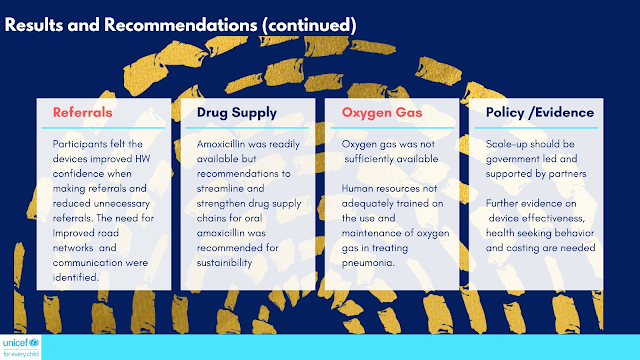
recommended scaling up the ARIDA intervention nationally. Health workers perceived the
devices as: time saving, highly acceptable by parents and children,
facilitating accurate diagnosis and referrals and decreasing referrals to higher
level facilities. Health workers perceived an increased demand for services,
reduced numbers of sick children not seeking care and perceived decreased death
rates from pneumonia. Participants recommended increasing the numbers of
devices and health workers trained with considerations for device maintenance
and power supply. Strengthening supply chains for amoxicillin and gentamicin,
improving oxygen gas availability, and strengthening referral networks would
maximize perceived benefits. While training improved knowledge, more supportive
supervision, integration with current guidelines and more days were
recommended. Participants recommended
more guidance, budget, planning and structure related to community engagement.
Government should lead efforts to scale-up the use of ARIDA devices with inputs
from across the health system and support from implementing partners.
Conclusions
Automated
RR counters have the potential to improve decentralized childhood pneumonia
diagnosis and management within communities. Health system considerations to
ensure sustainability of scaling efforts must be prioritized. Further research
is needed on the epidemiological impact, changes to pneumonia case management
(including health seeing behavior and rational drug use) and the return on
investment of intervention.
Wednesday, October 3, 2018
Poster HSR2018:Rural women’s preferences and knowledge for integrated, community-based self-collection for cervical cancer screening in Uganda: The ASPIRE Mayuge project
Publication JANAC:Patient Responses on Quality of Care and Satisfaction with Staff After Integrated HIV Care in South African Primary Health Care Clinics
Our latest research on Quality of Care and Satisfaction with Staff in HIV-Integrated Clinics in Free State, South Africa
Abstract:HIV care integrated into primary health care (PHC) encourages reorganized service delivery but could increase workload. In 2012-2013, we surveyed 910 patients and caregivers at two time points after integration in four clinics in Free State, South Africa. Likert surveys measured quality of care (QoC) and satisfaction with staff (SwS). QoC scores were lower for females, those older than 56 years, those visiting clinics every 3 months, and child health participants. Regression estimates showed QoC scores higher for ages 36-45 versus 18-25 years, and lower for those attending clinics for more than 10 years versus 6-12 months. Overall, SwS scores were lower for child health attendees and higher for tuberculosis attendees compared to chronic disease care attendees. Research is needed to understand determinants of disparities in QoC and SwS, especially for child health, diabetes, and hypertension attendees, to ensure high-quality care experiences for all patients attending PHC clinics with integrated HIV care.
- May 2018
- Journal of the Association of Nurses in AIDS Care 29(5)
- DOI:
- 10.1016/j.jana.2018.04.014
Publication JAIDS:Integrated Hiv-Care into Primary Care Clinics and the Influence on Diabetes and Hypertension Care: An Interrupted Time Series Analysis in Free State, South Africa Over Four Years
What happens to NCD care when HIV-care is integrated into Primary Health Care Clinics? Read more to find out.
To access the full text of this article, please visit the journal's website here.
If you do not have access to the journal, please read a draft version here.
Abstract:Background: Non-communicable diseases (NCDs), specifically diabetes and hypertension, are rising in high-HIV burdened countries like South Africa. How integrated HIV-care into primary health care (PHC) influences NCD care is unknown. We aimed to understand whether differences existed in NCD care (pre versus post-integration) and how changes may relate to HIV patient numbers. Setting: Public-sector PHC clinics in Free State, South Africa METHODS:: Using a quasi-experimental design, we analysed monthly administrative data on four indicators for diabetes and hypertension (clinic and population levels) during four years as HIV-integration was implemented in PHC. Data represented 131 PHC clinics (PHCCs) with a catchment population of 1.5 million. We utilised interrupted time series analysis at ±18 and ±30 months from HIV integration in each clinic to identify changes in trends post-integration compared to pre-integration. We utilised linear mixed effect models to study relationships between HIV and NCD indicators. Results: Patients receiving ART in the 131 PHC clinics studied increased from 1614 (April 2009) to 57, 958 (April 2013). Trends in new diabetes patients on treatment remained unchanged. However, population level new hypertensives on treatment decreased at ±30 months from integration by 6/100, 000 (SE=3,p<0.02) and was associated with the number of new HIV patients on treatment at the clinics. Conclusion: Our findings suggest that during the implementation of integrated HIV-care into PHCCs care for hypertensive patients could be compromised. Further research is needed to understand determinants NCD care in South Africa and other high HIV-burdened settings to ensure patient-centred PHC.
Wednesday, October 28, 2015
Effectiveness and Equity in integrated HIV care
We outline many of the benefits and challenges to health system effectiveness and equity for patients receiving care in integrated clinics. In April 2010, South Africa implemented of a policy providing comprehensive HIV care to public sector primary health care clinics. Through focus group discussions with health care works and key informant interviews with a variety of health system actors, we were able to see how our participants viewed the impact on patients.
Here is a link to the abstract https://apha.confex.com/apha/143am/webprogram/Paper333097.html
Thursday, August 6, 2015
What can we learn from the HIV response to shift the paradigm in health systems research?
Read my featured article on the International Health Policies website hosted by the Institute of Tropical Medicine in Antwerp. Click here.